Token economics
What Is Token Supply and Why Does It Matter?
Understand total, circulating and maximum token supply, how minting and burning change supply on Solana, and why token distribution matters.
On this page
What does token supply actually mean?
The number of units of a token that have been created and are currently counted as part of its supply. The exact figure and its meaning depend on the supply metric being discussed.
A token's supply is one of the first numbers people look at when evaluating a crypto project. But a figure such as 1 billion tokens tells you very little on its own. Are all those tokens available to trade? Can more be created? Are some locked for several years? These questions matter far more than the headline number.
💡 The three figures to distinguish
Total supply tells you how many tokens currently exist according to the token's mint. Circulating supply estimates how many are available to the market. Maximum supply is the upper limit, if the project and token design actually establish one.
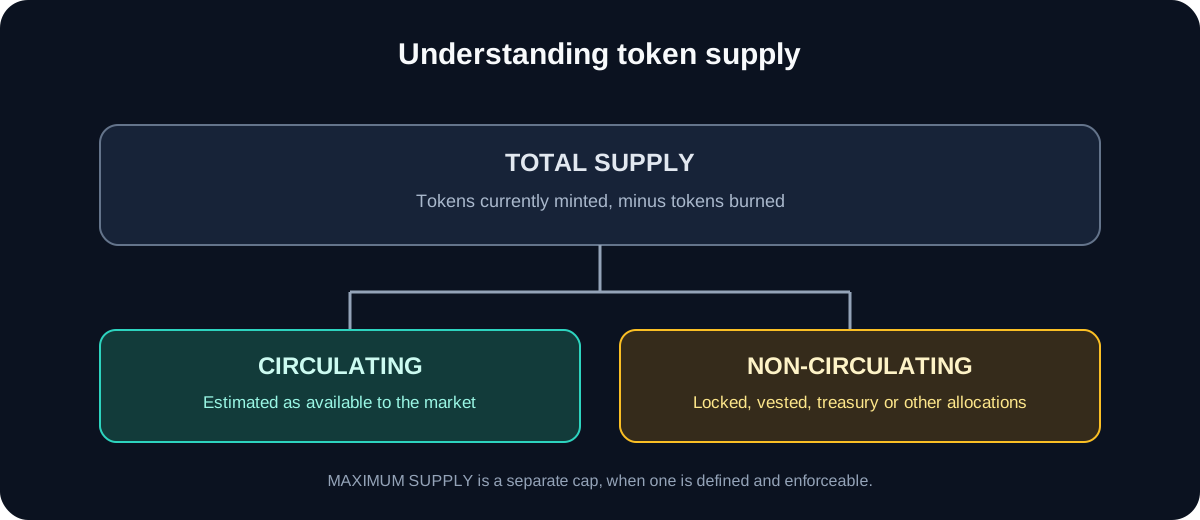
Total supply, circulating supply and maximum supply
These terms are often used interchangeably, even though they answer different questions. Always check which metric a website is displaying before comparing two tokens.
| Metric | What it means | What to watch |
|---|---|---|
| Total supply | The number of tokens currently minted, minus tokens that have been burned. | It can change through minting or burning. On Solana, the mint account records the token's supply. |
| Circulating supply | An estimate of tokens considered available to the public market. | There is no single universal methodology. Locked, vested, treasury or insider allocations may be excluded, depending on the data provider. |
| Maximum supply | The maximum number of tokens that can ever exist, if a credible cap is defined. | A published tokenomics target is not necessarily an enforceable on-chain limit. Check the minting permissions and the mechanism that enforces the cap. |
⚠️ Circulating supply is an estimate
Unlike the on-chain mint supply, circulating supply often relies on classifications made by a project or data provider. Two platforms can therefore report different circulating supply figures for the same token.
How token supply works on Solana
On Solana, a token is identified by its mint account. The mint stores the current supply, decimal precision and mint authority. Individual token accounts hold balances for specific owners, while the mint account records the supply for the token as a whole.
When the mint authority creates new tokens, the mint's total supply increases and the destination token account receives the new balance.
A transfer moves tokens between accounts. It changes who holds them, but does not by itself increase or decrease the mint's total supply.
A burn removes tokens from a token account and reduces the mint's total supply by the same amount.
If the mint authority is permanently set to none, no new tokens can be minted through that authority. The existing supply can still decrease if tokens are burned.
ℹ️ A fixed supply is not necessarily a maximum supply written in code
For a standard Solana mint, revoking Mint Authority fixes the supply at its current level by removing the ability to mint more. It does not prevent existing tokens from being transferred or burned.
A simple example: why the supply breakdown matters
Imagine a project that has minted 1 billion tokens. Its tokenomics page says that 300 million are circulating, while the rest are allocated to the team, treasury, ecosystem incentives and future distributions.
| Illustrative allocation | Tokens | Share of total supply |
|---|---|---|
| Circulating | 300 million | 30% |
| Team and contributors | 200 million | 20% |
| Treasury and ecosystem | 250 million | 25% |
| Vesting and future incentives | 250 million | 25% |
| Total | 1 billion | 100% |
The example does not mean that all 700 million non-circulating tokens are locked in the same way. Some may be subject to a vesting schedule, some may sit in a treasury wallet, and some may be reserved for future incentives. Those arrangements have different implications for future supply entering the market.
💡 Look beyond the allocation chart
For each large allocation, identify the wallet or vesting contract, who controls it, when tokens can be released and whether the schedule can be changed. A pie chart is a claim. The underlying accounts and contracts are the evidence.
How supply affects market capitalization and token price
Supply is important because token prices are usually discussed alongside market capitalization. A common calculation is market capitalization = token price × circulating supply. If a token trades at $2 and has 100 million circulating tokens, its implied market capitalization is $200 million.
The same price can imply very different valuations depending on the number of tokens in circulation. A token priced at $0.01 is not automatically cheap, just as a token priced at $100 is not automatically expensive. The number of units and the valuation matter together.
⚠️ A low unit price does not mean a token is undervalued
A project can choose a very large supply and a correspondingly small unit price. Compare market capitalization, supply, distribution and liquidity rather than judging a token by its price per coin.
Some platforms also display fully diluted valuation (FDV), commonly calculated using the token price multiplied by a stated maximum or fully diluted supply. If no credible maximum supply exists, the figure may rely on an assumed supply and can be misleading. Always check the methodology.
Why future token unlocks and dilution matter
When new tokens enter circulation, existing holders may own a smaller percentage of the total supply. This is often called dilution. It does not automatically mean the price must fall, but it can create additional selling pressure if newly available tokens are sold rather than held or used productively.
Check when team, investor, treasury and ecosystem allocations become transferable.
A release to a broad user community is different from a large allocation becoming available to a small group of insiders.
A release of 20 million tokens has a different impact when 100 million are circulating than when 2 billion are circulating.
Look for vesting contracts, on-chain balances and the authority that controls the allocation. Do not rely only on a project's infographic.
ℹ️ Locked does not mean burned
Tokens held in a vesting contract or a locked wallet generally remain part of total supply. Locking restricts access or transferability; burning reduces the mint's supply.
How to check a token's supply before investing
Use the exact mint address from a trusted source. A token name or ticker alone is not enough to identify the asset.
Open the mint on Solscan or Solana Explorer and inspect its supply, decimals and mint authority.
Check whether market data sites show total, circulating and maximum supply, and read how they define each figure.
Review large holder accounts, treasury wallets and vesting contracts. Identify who controls them and when funds become transferable.
Compare market capitalization, liquidity and upcoming unlocks. No single supply metric gives a complete picture.
What token creators should define before launch
If you are launching a token, decide on the supply before distributing it. The initial supply, decimal precision, allocation plan, minting policy and vesting schedule should form one coherent design. Changing the numbers later can undermine confidence, especially if holders do not understand why new tokens are being created.
Choose the number of units and decimals for practical reasons. A large token count does not create value by itself.
Explain how much goes to liquidity, the team, the treasury, users and future incentives.
Decide whether the supply should be fixed at launch or whether future minting is genuinely required.
Use transparent schedules and on-chain contracts for allocations that should unlock over time.
💡 Build trust through verifiable decisions
A credible token launch is not about choosing an impressive supply number. It is about making the supply, permissions and distribution understandable and verifiable.
Frequently Asked Questions
What is the difference between total supply and circulating supply?
Total supply is the number of tokens currently minted, minus tokens burned. Circulating supply is an estimate of the tokens considered available to the public market. Locked, vested or treasury allocations may be excluded, depending on the methodology.
Does burning tokens reduce total supply?
Yes. On Solana, a token burn reduces the balance of the relevant token account and decreases the mint's total supply by the same amount.
Does revoking Mint Authority make the supply fixed?
It prevents any further minting through that mint authority. The existing supply can still decrease through token burns.
Do locked tokens count as total supply?
Generally, yes. Tokens in a vesting contract or locked wallet have already been minted and remain part of total supply. They may be excluded from circulating supply depending on the data provider's methodology.
What is maximum supply?
Maximum supply is the upper limit of tokens that can ever exist, if one is defined and enforced. A number shown in a tokenomics document is not necessarily an on-chain restriction.
Does a lower token price mean a token is cheaper?
No. Unit price must be considered alongside circulating supply and market capitalization. A very large supply can result in a low unit price without making the project undervalued.
Where can I check a Solana token's total supply?
Use the token's exact mint address on Solscan or Solana Explorer. The mint account records its supply and decimal precision.
Ready to launch your own token?
Create an SPL token directly on Solana in less than a minute. No coding. No custody. Everything happens on-chain from your wallet.
Create your token →Continue reading
What is an SPL Token? A Beginner's Guide to Solana Tokens
Learn what an SPL Token is, how it works, what information it contains, and how it differs from Ethereum's ERC-20 standard.
What is Mint Authority?
Learn what mint authority is on Solana, why it matters for your token, and when you should revoke it.
How to Create a Solana Token
Learn how to create your own SPL Token on Solana in just a few minutes, from choosing a name to verifying it on-chain.
How to Create a Vesting Contract on Solana
Learn how to lock tokens with a vesting contract, choose the right parameters and distribute tokens securely using Streamflow.
How to Check if a Solana Token Is Safe Before Buying
A practical checklist to assess a Solana token before buying: authorities, Token-2022 extensions, holder distribution, liquidity and on-chain activity.
How to Create a Liquidity Pool on Solana
Learn how to create a liquidity pool on Solana, set your token's initial price and make it tradable on decentralized exchanges.